Best AI SEO Reporting Tools to Try in 2026
Why AI SEO Reporting Tools Matter in 2026
If you're still stitching together SEO reports from five different platforms into a spreadsheet each week, you're not alone. But you're also losing time your competitors aren't.
The SEO landscape of 2026 demands speed and precision that manual reporting simply can't deliver. Your rankings matter on Google, yes, but they also matter on ChatGPT, Gemini, Perplexity, and other AI search engines reshaping how people find information. Tracking performance across these new channels while monitoring traditional metrics creates data overload. Studies show that 66% of marketing leaders recognize automation and machine learning as essential for freeing teams from tedious tasks.
Here's the practical reality: manual reporting consumes hundreds of hours annually and introduces human error at every step. Data aggregation from multiple sources is error-prone. Insights arrive too late to act on them. Your team spends more time formatting reports than analyzing performance.
AI SEO reporting tools solve this by automatically pulling data from Google Search Console, analytics platforms, rank trackers, and content tools into a single, organized dashboard. But not all tools claiming "AI" deserve the investment. Some are essentially glorified content spinners lacking genuine data quality. The best ones use actual machine learning to identify patterns, flag opportunities, and surface what matters most to your business.
The shift from manual to intelligent automation isn't optional anymore. It's how teams stay competitive.
Top AI SEO Reporting Tools Compared
The AI SEO reporting tools market has matured significantly, moving beyond basic rank tracking to deliver genuine intelligence. Here's how the leading options stack up.
Semrush Copilot integrates data from Google Search Console, Google Analytics, and your SEO metrics into a single AI assistant that surfaces actionable recommendations. It's best for teams already invested in Semrush's broader platform; expect to pay $120-$449/month depending on your plan tier. The strength here is context; the AI understands your complete SEO picture, not isolated metrics.
SE Ranking combines comprehensive SEO platform with AI search tracking across ChatGPT, Gemini, Perplexity and other generative engines. This matters because traditional rank tracking misses where your content actually appears. Pricing starts at $55/month for core features, scaling to $249/month for enterprise needs. It's ideal if you're tracking visibility across multiple AI search interfaces.
Whatagraph takes a different approach, aggregating data from SEO tools, analytics platforms, and advertising channels into branded reports generated in seconds. Rather than analyzing data itself, it consolidates and visualizes it beautifully. Pricing ranges from $29-$489/month based on data volume and integrations. Use this if your team juggles multiple tools and you're drowning in disconnected dashboards.
Otterly AI specializes in something most tools ignore: GEO (Generative Engine Optimization) visibility tracking. It monitors whether your content appears in AI-generated summaries on Google, ChatGPT, and other platforms. At $99-$299/month, it's narrower in scope but essential if AI visibility is a strategic priority for your brand.
Emerging consideration: Tools like Whatagraph documentation show how modern reporting platforms treat data consolidation as the core feature, letting AI focus on what it does best: pattern recognition and recommendations.
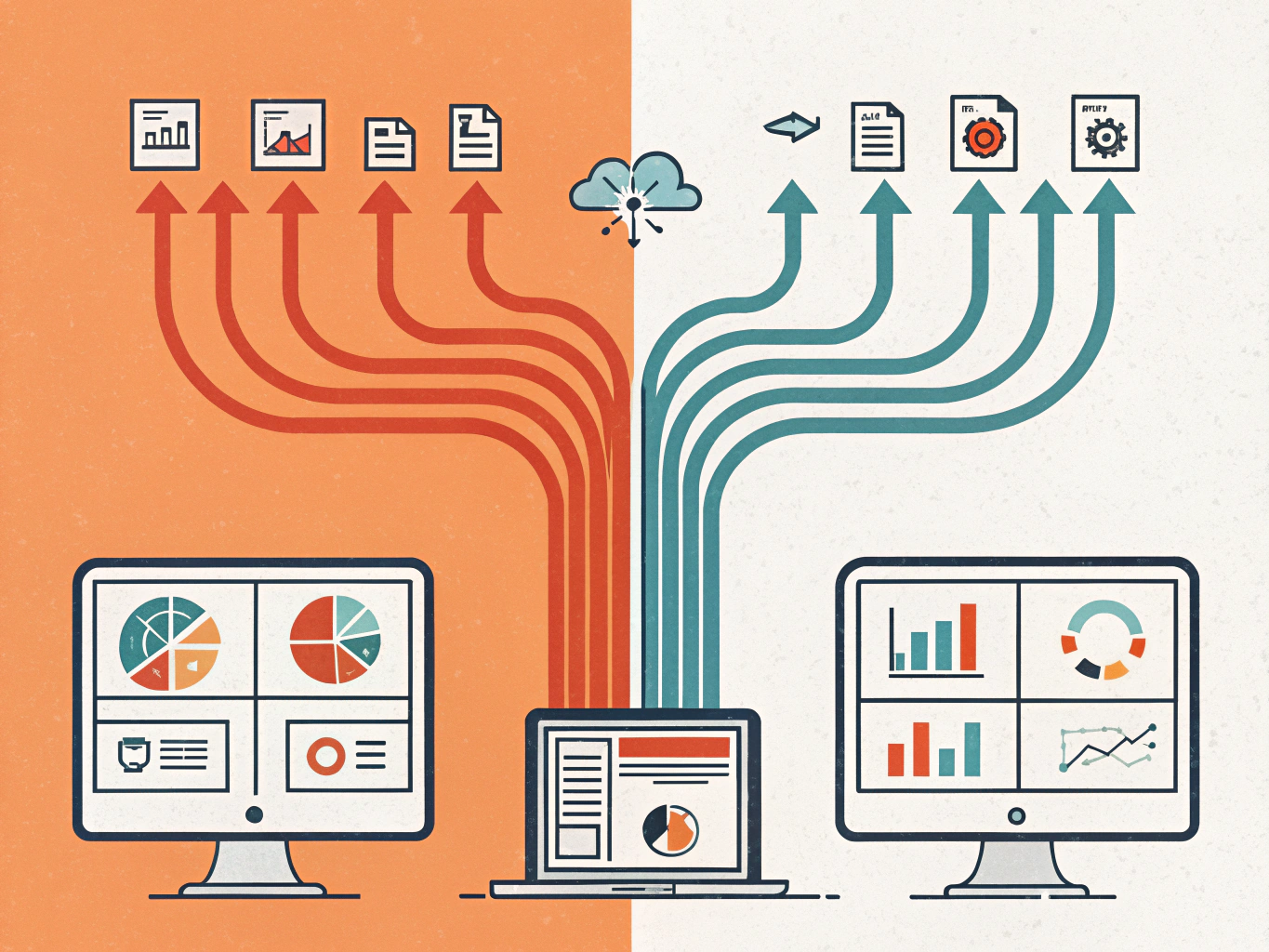
The right tool depends on your workflow. If you need AI-powered recommendations within an existing platform, Semrush wins. If you're tracking visibility across generative engines, SE Ranking delivers. If you simply need to consolidate fragmented data sources, Whatagraph handles it elegantly. The common thread: genuine AI tools save hours weekly by automating what humans used to do manually in spreadsheets.
How AI Reporting Tools Automate Your Workflow
Imagine spending hours each week manually pulling data from Google Search Console, GA4, and your SEO tools, only to paste everything into a spreadsheet and hunt for patterns. AI reporting tools eliminate this entirely.
Modern platforms automatically aggregate metrics from multiple sources into a single dashboard. Your ranking data, traffic changes, backlink growth, and conversion metrics sync without lifting a finger. This alone saves agencies and in-house teams 5-10 hours weekly.
The real efficiency gain comes from AI-generated insights. Rather than staring at raw numbers, you get natural language summaries explaining what changed and why. Instead of "Keyword X moved from position 12 to position 8," the tool tells you: "Your new content targeting long-tail variants drove this ranking improvement. Similar optimization opportunities exist for three related keywords." Modern platforms generate natural language explanations of why metrics changed and recommended actions.
Scheduling automates client communication. Set reports to deliver every Monday morning or monthly on the 1st. White-label features mean clients see your branding, not the tool's, strengthening your agency positioning. No more manual report building or last-minute formatting.
Real-time alerts are the third pillar. Significant ranking drops or traffic spikes trigger instant notifications, letting you respond before clients ask questions. Catch algorithm impacts or technical issues hours earlier than traditional weekly reviews.
For teams managing multiple accounts, this automation compounds. What took one person two days now takes 30 minutes. Errors drop because data flows directly from source systems rather than passing through human transcription. Your team shifts from data wrangling to strategy, analyzing insights instead of generating them.
The best part: these capabilities aren't reserved for enterprise tools anymore. Mid-market platforms now offer genuine automation that justifies their cost through time savings alone.
AI Search Visibility: The New Reporting Essential
The search landscape shifted in 2025. Today, your content competes not just for Google rankings, but for mentions in AI-generated answers across ChatGPT, Gemini, Perplexity, and Google AI Overviews. Traditional keyword position tracking alone no longer tells the complete story.
AI search visibility tracking measures how often your brand appears when users query these platforms. It's fundamentally different from ranking for a keyword; you're being cited as a source within an AI's synthesized response. SE Ranking's AI Visibility Tracker monitors brand mentions across ChatGPT, Gemini, Perplexity, and Google AI Overviews, giving you visibility into a channel that now drives significant traffic and authority signals.
Why this matters: AI overviews now appear on standard Google searches, meaning a user might never click a traditional blue link. Instead, they read your information summarized in an AI answer. If you're not being mentioned, you're invisible to that user. If you are, you gain credibility and traffic without a click.
Modern AI SEO reporting tools track both metrics simultaneously, showing you where you rank traditionally and how often you appear in AI-generated content. This dual reporting is essential for justifying SEO investment to leadership and clients. You can demonstrate impact across emerging channels, not just legacy metrics.
The capability to monitor AI visibility separates forward-thinking platforms from outdated tools still focused solely on traditional rankings. By 2026, this isn't an optional feature; it's baseline table stakes for any serious SEO reporting solution.

Pricing and Feature Breakdown for Every Budget
AI SEO reporting tools span a wide range of budgets, but the cheapest option isn't always the best value. Entry-level tools start around $29-$50 per month, though many restrict AI capabilities to premium tiers or cap monthly analysis requests. You'll get basic reporting here, but automation and intelligent insights often require upgrading.
Mid-tier platforms, typically $100-$300 monthly, offer the sweet spot for most marketing teams. This range includes full automation, unlimited monthly usage, and AI-powered features like anomaly detection and predictive recommendations. Most agencies find this tier covers their core needs without overspending.
Enterprise solutions jump to $500-$5,000+ monthly for large agencies managing multiple client accounts or complex reporting requirements. These tiers include dedicated support, custom integrations, and advanced AI models trained on your specific data.
The real cost consideration: consolidation. Buying one comprehensive platform often costs less than piecing together three specialized tools. Calculate your current spending across separate rank trackers, analytics dashboards, and reporting software, then compare it to an all-in-one solution's price tag.
Watch for hidden costs. Some platforms advertise low base prices but charge extra per user seat, API calls, or advanced AI features. Read the fine print on what's included at each tier before committing.
Don't let sticker shock push you toward inadequate tools. A $150-monthly platform with robust AI automation typically delivers better ROI than a $50-monthly option requiring manual data exports and spreadsheet work. Factor in the hours your team saves each week; that's where real value emerges.
Best Practices for Getting Maximum Value from AI Reporting Tools
Getting the most from AI SEO reporting tools requires intentional setup and ongoing discipline. Start by connecting your tools to your existing ecosystem: Google Analytics 4, Google Search Console, your CMS, and any other platforms where your data lives. Seamless integration eliminates manual data entry and reduces errors that compound over time.
Automation is powerful, but it's not a substitute for judgment. Use AI to flag patterns, surface anomalies, and generate recommendations; then verify those insights before acting. A tool might suggest aggressive keyword targeting based on volume data, but only you understand your audience's intent and your content strategy. The combination of machine intelligence and human expertise beats either one alone.
Structure your reporting around stakeholder needs, not just available metrics. Your executive team needs different KPIs than your content creators or technical SEO specialists. Set up automated reports tailored to each group so stakeholders see what actually matters to their work. This prevents report fatigue and ensures recommendations get action.
Every six months, audit your tool stack honestly. You probably have some overlap or features you're paying for but not using. Consolidating tools cuts costs and reduces the cognitive load on your team. One excellent reporting platform beats three mediocre ones.
Finally, invest in team training. When your writers and developers understand what the AI is measuring and why, they make smarter decisions with the insights it provides. They'll also catch false positives faster and contribute better context for the tool's next iteration.
AI reporting tools accelerate your SEO workflow, but they work best when your team treats them as collaborators, not oracles.
The Future of AI SEO Reporting
The line separating traditional SEO tools from AI-powered platforms will essentially disappear by the end of 2026. What once felt like a premium feature will become baseline functionality, and teams that haven't adapted will find themselves at a significant disadvantage.
Predictive analytics represents the next frontier. Rather than analyzing what happened last month, you'll forecast ranking impacts before implementing changes. This shift from reactive to proactive means fewer wasted efforts and faster wins.
Integration with emerging AI search surfaces isn't coming; it's already here and accelerating. Tools that seamlessly connect with new search paradigms will dominate, while those clinging to traditional metrics will fade.
The real competitive advantage belongs to platforms that evolve fastest when algorithms shift. Google changes the rules constantly, and your reporting tool needs to keep pace automatically, not require manual updates from your team.
Here's the critical insight: the best tool isn't the most feature-rich. It's the one your team actually uses and trusts. Choose something that fits your workflow, delivers insights you understand, and doesn't require a PhD to operate. When your team stops fighting the tool and starts relying on it, that's when SEO reporting transforms from overhead into strategy.
FirstSearch
FirstSearch.AI Team