Best AI Tools for Content Creation 2026: Complete Guide
Last Updated: February 7, 2026
TL;DR: Key Takeaways
- 87% of creators now use AI tools; choose based on your primary content format (writing, design, video, SEO)
- ChatGPT, Jasper, and Claude lead writing; Canva and Visme dominate design; Descript excels at repurposing
- Surfer SEO and Frase AI combine content creation with competitive intelligence and SEO optimization
- Free tiers from ChatGPT, Gemini, and Perplexity offer genuine value; paid tools unlock speed and volume
- Success requires human oversight: AI generates drafts faster, but strategy and brand voice remain human responsibilities
Table of Contents
- Why AI Content Creation Tools Matter in 2026
- Writing and Drafting AI Tools: ChatGPT, Jasper, and Claude
- SEO-Optimized Content Creation: Surfer SEO, Frase AI, and Clearscope
- Visual Content and Design: Canva AI, Visme, and Adobe Tools
- Video and Multimedia: Descript, Lumen5, Synthesia, and HeyGen
- Free AI Tools for Content Creation That Actually Work
- How to Choose the Right AI Content Tool for Your Workflow
- Conclusion: Your AI Content Creation Strategy for 2026
Why AI Content Creation Tools Matter in 2026
If you're still thinking about AI content creation as just ChatGPT, you're already behind. 87% of content creators now use AI in their creative workflows, and 75% of marketers admit to using AI tools to some degree. This isn't a trend anymore; it's the baseline.
Here's what changed: the conversation shifted from "should we use AI?" to "which tools actually work for our specific needs?" That's the real competitive advantage in 2026.
Consider the math. A typical 500-word blog post takes around 4 hours to complete when done manually. With the right AI toolkit, you're looking at minutes. That's not about cutting corners; it's about reclaiming time for strategy, editing, and what actually moves the needle.
The gap between free and premium tools isn't about raw intelligence anymore. ChatGPT's free version is genuinely capable. The real differences are volume limits, specialized features for specific workflows, and integration capabilities. A solopreneur might thrive on free tools; an agency managing 50 clients needs something entirely different.

The tools that matter aren't one-size-fits-all. They're specialized. And that's exactly what we're breaking down here.
Writing and Drafting AI Tools: ChatGPT, Jasper, and Claude
ChatGPT, Jasper, and Claude represent three distinct approaches to AI-powered writing, each with meaningful strengths depending on your needs.
ChatGPT remains the Swiss Army knife of content creation. Whether you're brainstorming blog structures, drafting social posts, or outlining long-form pieces, it adapts quickly across formats. The free version handles most tasks competently, but ChatGPT Plus with GPT-4 and Deep Research delivers noticeably sharper outputs for complex topics. You'll appreciate its speed for ideation and rough drafts, though it occasionally struggles with maintaining consistent brand voice across multiple pieces without careful prompting.
Jasper is purpose-built for marketers who need to move faster. It includes 50+ templates for everything from email copy to product descriptions, plus built-in SEO optimization and plagiarism detection. The real advantage emerges once you've trained its brand voice feature with your existing content; subsequent outputs feel authentically "yours" with minimal revision. Setup takes time upfront, but teams writing dozens of pieces monthly see substantial efficiency gains. Jasper's marketing-focused design appeals specifically to agencies and in-house marketing departments.
Claude excels where length and nuance matter. It retains context better across longer documents, making it superior for comprehensive guides, detailed product content, or sensitive topics requiring measured reasoning. Its outputs feel less "AI-generated" and more thoughtfully constructed. If you're writing pieces exceeding 2,000 words, Claude often requires fewer revision rounds than competitors.
The practical choice depends on your workflow. Use ChatGPT for speed and versatility; choose Jasper if brand consistency and template efficiency matter; pick Claude for long-form depth. Many content teams actually use all three, routing different projects accordingly.
SEO-Optimized Content Creation: Surfer SEO, Frase AI, and Clearscope
Here's your section:
General writing tools like ChatGPT excel at generating copy, but they miss a critical step: search visibility. SEO-focused AI tools solve this problem by analyzing what actually ranks and building content around those insights.

Surfer SEO analyzes the top-ranking pages for your target keyword and gives you a roadmap. Its real-time Content Score tells you exactly which keywords to include, optimal article length, and the structure that competitors use. Rather than guessing at optimization, you're working from data. Pricing starts at $89 monthly for individuals.
Frase AI takes a different approach by combining research with content creation. It analyzes what's already working in your niche, then helps you create something better. The tool generates content briefs that identify gaps and opportunities, saving hours of manual research. It integrates seamlessly with Google Docs and WordPress, meaning you're not juggling multiple platforms.
Both tools eliminate the tedious optimization phase that typically requires manual keyword placement and structural adjustments. Instead of writing first and optimizing later, you're building optimization into the creation process from the start.
These tools work best when you're competing in saturated niches where ranking requires precision. If you're targeting keywords with established top results, SEO-focused AI gives you the competitive intelligence needed to break through. For budget-conscious teams, they're worth the investment because they compress weeks of optimization work into days.
Visual Content and Design: Canva AI, Visme, and Adobe Tools
Visual content stops the scroll. In 2026, pairing AI with design tools means anyone can produce graphics that rival professional designers without years of training.
Canva's Magic Studio features enable quick creation of blog headers and infographics. Describe what you want ("a bold header for a productivity blog post about remote work"), and Magic Design generates custom templates in seconds. Magic Write handles headlines and captions while the background remover strips away distractions with unsettling accuracy. For content creators managing multiple channels, this cuts design time from hours to minutes.
Visme has become a go-to hub for visual content creation with AI Hub tools. Beyond templates, it offers a complete design platform with infographic builders, presentation creators, and brand kit management. The AI assists with layout suggestions and copy, making it ideal if you need variety across formats.
For marketers wanting professional-grade results, Adobe's tools are bringing pro-grade editing to AI-assisted workflows. Firefly integrates generative AI directly into Creative Cloud, letting you expand images, remove objects, or generate backgrounds without leaving your familiar workspace. It's the choice when quality and brand consistency matter most.
The math is simple: visual content generates 40% more engagement than text alone. Pair that with AI acceleration, and you're creating more assets faster, across blogs, social feeds, and presentations. These tools democratize design, letting you focus on strategy instead of struggling with software.
Video and Multimedia: Descript, Lumen5, Synthesia, and HeyGen
Video content commands attention in 2026, yet most marketers skip it due to production complexity and cost. AI video tools flip that equation entirely.
Descript treats video like text. Upload a podcast or interview, and the tool transcribes it automatically. You edit by deleting words from the transcript, and the video cuts itself. It's surprisingly powerful for extracting 60-second clips from hour-long recordings, perfect for LinkedIn or email campaigns. The interface feels natural if you've ever written anything.
Lumen5 solves a different problem: converting blog posts into animated videos in minutes. Feed it your written content, and the tool pulls relevant visuals, adds motion, and syncs everything to music. It's ideal for repurposing evergreen blog posts into social content without re-recording anything. Lumen5 converts your written content into animated video in minutes, making it accessible even for solo creators.

Synthesia and HeyGen take scalability further with AI avatars. Both create talking-head videos without actors or cameras. Synthesia creates videos in 65 languages, saving up to 80% of their time and budget. HeyGen matches this with multi-language support and customizable avatars. For teams managing global campaigns or frequent product updates, these tools eliminate the bottleneck of booking talent and studios.
The real win: repurposing. One podcast becomes a blog post, clip compilation, animated explainer, and avatar-narrated summary. Your content multiplies across platforms without re-recording.
Free AI Tools for Content Creation That Actually Work
Quality content creation doesn't require a credit card. Here's what actually works in the free tier.
ChatGPT Free remains your solid foundation. You get GPT-4o-mini with file uploads and web browsing, which handles drafting, outlining, and ideation without restrictions. The limitation? You're capped at message volume during peak hours. For most solo creators and small teams, this rarely matters.
Google Gemini deserves attention if you live in Google Workspace. The free version integrates directly with Docs, Sheets, and Gmail in ways ChatGPT simply can't match. It's not flashier, but the workflow efficiency is real. You avoid context-switching between tools.
Perplexity solves a specific problem: research with citations. Rather than asking ChatGPT and fact-checking its sources, Perplexity pulls real-time information from the web and shows you exactly where it came from. Perfect for news angles, trend reports, and data-backed claims.
Canva Free covers the visual gap. You get templates for social posts, presentations, and basic graphics. Advanced features like brand kits and animation require paid plans, but foundational design work is genuinely capable.
Here's the truth: 87% of content creators now use AI, and the gap between free and paid tools is about volume and advanced features, not core intelligence. Free tools won't handle massive batch operations or specialized workflows, but they'll produce legitimate, usable content.
Think of free tools as your starting point, not your ceiling. Many successful creators operate entirely within this stack.
How to Choose the Right AI Content Tool for Your Workflow
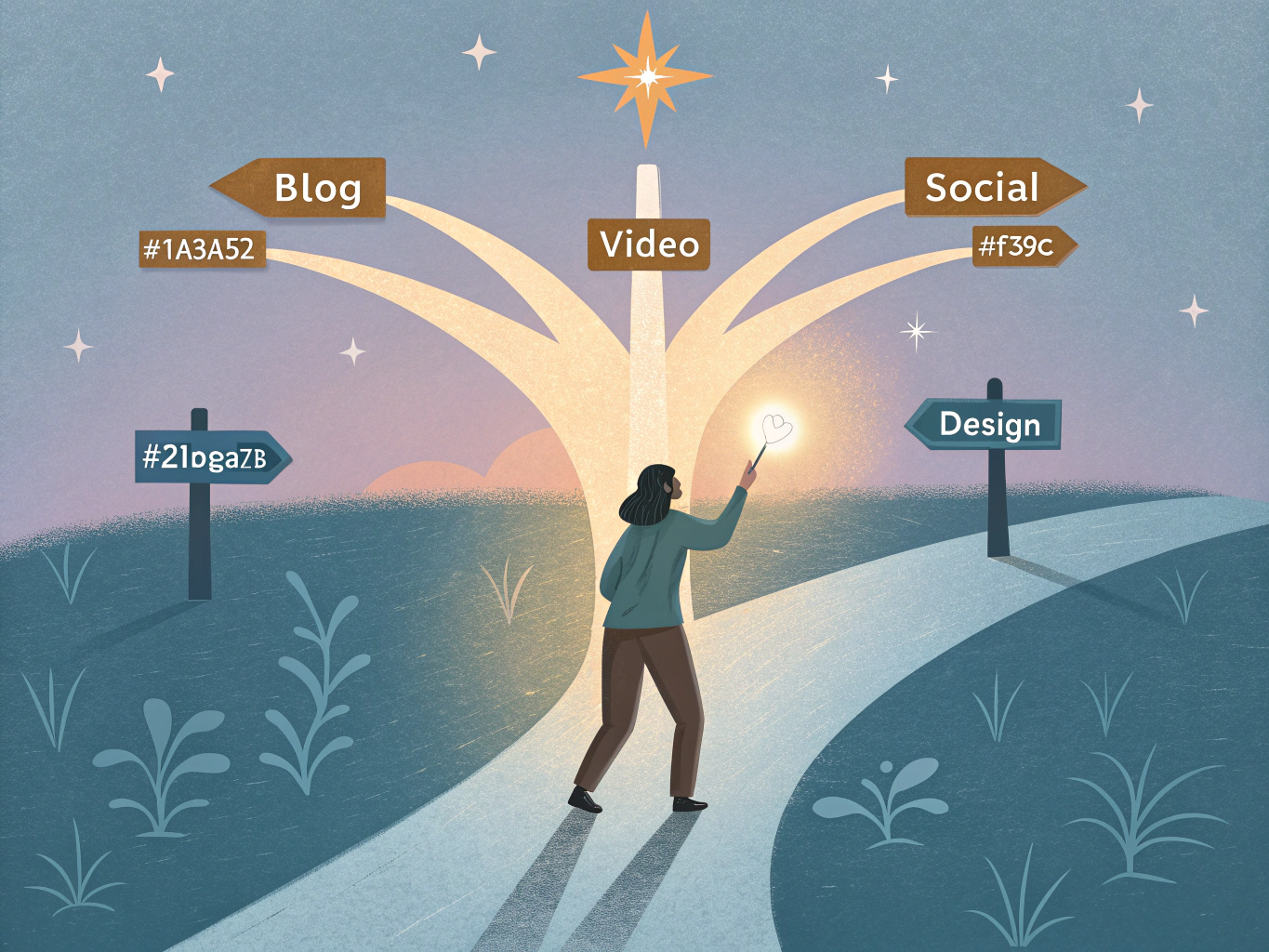
The best AI tool isn't the most powerful one; it's the one you'll actually use. Start by identifying your primary content format. Are you writing long-form blogs, crafting social media posts, producing videos, or designing graphics? Tools built specifically for your format will save you weeks of trial and error.
Next, evaluate candidates on four criteria: output quality (does it match your brand voice?), ease of use (can your team adopt it quickly?), core functionality (does it handle your main tasks?), and unique features (what sets it apart for your specific needs?).
Test before buying. Most tools offer free trials or generous free tiers; use them on actual projects for a week. Real-world testing beats any feature comparison.
Start with one tool for your dominant content type. Resist the urge to adopt five platforms simultaneously. Master one, then expand.
Here's what matters most: you can have the best AI tools in the world, but without structure, process, and human oversight, you're publishing faster, not better. AI handles speed; you handle strategy, voice, and accuracy. The proven workflow is drafting with AI, optimizing with SEO tools, then tracking results with analytics.
Your tool stack should evolve with your needs, but consistency beats perfection every time.
Conclusion: Your AI Content Creation Strategy for 2026
The truth is simple: in 2026, AI content creation isn't optional anymore. 82% of businesses use AI in some form to boost their work processes, and those sitting on the sidelines are losing ground to competitors who've already scaled.
But here's what matters most: success doesn't come from one tool. It comes from a specialized stack tailored to your needs, budget, and goals. The right combination multiplies your productivity by 3 to 5 times while keeping quality intact.
Start small. Pick one or two free tools this week, test them on real content, measure the results. Does it save time? Does it improve your output? Then upgrade strategically to paid options that genuinely move the needle.
Remember this crucial point: AI executes faster, but you still own the strategy. Your brand voice, your audience insights, your editorial judgment remain irreplaceable. AI is the accelerant, not the replacement.
The final piece? Connect your content creation workflow with SEO optimization and analytics. Content without visibility is just noise. Check out our ultimate guide to SEO automation tools and content optimization checklist to tie everything together.
The time to build your stack is now.
FirstSearch
FirstSearch.AI Team