Content Performance Tracking: Metrics That Drive Real Results
Last Updated: April 11, 2026
Key Takeaways
- Content performance tracking measures how well your content achieves business goals, not just vanity metrics
- Focus on 3-5 primary metrics aligned with your specific content goals to avoid data overload
- Essential metrics include engagement (time on page, bounce rate), conversions, organic traffic, and AI visibility
- Use tools like Google Analytics, Google Search Console, and AI visibility trackers for comprehensive measurement
- Regular benchmarking against industry standards and your own baselines drives continuous improvement
What Is Content Performance Tracking?
Content performance tracking measures how well your content achieves its intended goals. It's the systematic process of collecting, analyzing, and interpreting data to understand what's actually working in your content strategy, not just what looks impressive on the surface.
Here's the critical distinction: many marketers confuse activity with performance. Pageviews, likes, and shares feel good, but they're vanity metrics. They don't tell you whether content is driving conversions, building authority, or generating revenue. Real performance tracking focuses on outcomes that matter to your business: lead generation, customer acquisition, engagement depth, and measurable ROI.

Why does this matter? Because tracking content performance transforms how you allocate resources. Instead of guessing which topics resonate or which formats work best, you're making decisions backed by data. You'll identify which pieces drive qualified traffic, which content nurtures prospects through your sales funnel, and where you're wasting effort.
This approach also builds credibility with stakeholders. When you can prove that your content strategy directly impacts revenue or customer acquisition, you stop defending your work and start expanding your budget. Content performance tracking isn't about collecting metrics for their own sake; it's about understanding precisely what drives results, then doing more of it.
Why Content Performance Tracking Matters
Without content performance tracking, you're essentially flying blind. You're creating, publishing, and hoping something sticks. That's not strategy; it's gambling with your resources.
Here's the reality: some of your content drives real business results while other pieces consume time and budget with minimal impact. Content performance tracking reveals which is which. It transforms vague hunches into concrete data you can act on immediately. Instead of debating whether that blog post or video was "worth it," you have numbers that settle the question.
The business case is compelling. When you track performance systematically, you identify your highest-performing content and double down on what works. This directly improves ROI because you're allocating resources toward proven winners rather than spreading efforts thin across mediocre pieces. Content performance analysis helps elevate content production and ensure alignment with business objectives, which means your strategy stays connected to actual business goals.
Beyond immediate metrics, tracking builds stakeholder confidence. When leadership questions your content budget, you don't offer opinions; you present data. You show exactly how content correlates with conversions, revenue, or other metrics that matter to your organization.
The landscape is shifting, too. AI search visibility now demands attention. AI visibility measures how prominent your brand is in AI-generated responses like Google's AI Overviews, ChatGPT, and Gemini, and this metric is becoming essential as more users rely on AI tools for answers rather than traditional search. Missing this means overlooking how your content performs in an increasingly AI-driven discovery environment.
The bottom line: tracking content performance enables faster optimization cycles, stronger alignment with business goals, and the confidence to make bold decisions backed by evidence rather than instinct. In competitive markets, that advantage compounds quickly.
Essential Content Performance Metrics to Track
Not all metrics deserve equal attention. The ones that matter depend entirely on what you're trying to achieve with your content, which is why building a focused tracking framework beats drowning in dashboards full of meaningless numbers.
Engagement Metrics: How Your Audience Interacts
Engagement metrics reveal whether people actually care about your content once they land on it. Time on page shows how long visitors spend reading, while bounce rate indicates the percentage who leave without taking further action. Scroll depth is particularly valuable because it tells you exactly how far down the page people read before losing interest. These metrics expose content quality issues fast. A high bounce rate combined with low scroll depth signals that your headline promised something your content didn't deliver.
Visibility Metrics: Reaching Your Target Audience
Before engagement or conversions happen, your content needs to be found. Visibility metrics show whether blog content is reaching an audience in the first place. Organic traffic tracks visitors from search engines, while keyword rankings show where your content appears in results. AI visibility has become critical as users increasingly rely on AI search tools for answers. Traditional organic traffic numbers alone no longer tell the complete visibility story.

Conversion Metrics: Measuring Business Impact
Ultimately, content exists to drive business results. Conversion rate measures the percentage of visitors completing desired actions like signing up for newsletters or requesting demos. Lead generation volume shows how many qualified prospects your content attracts, while ROI connects content investments directly to revenue. These metrics prove content's worth beyond vanity numbers.
The key is choosing three to five metrics aligned with your specific goals rather than tracking everything. A blog focused on brand awareness needs different priorities than one designed to generate sales leads. Start with visibility and engagement metrics to establish baseline performance, then layer in conversion metrics once you understand your audience's behavior.
Tools and Platforms for Content Performance Tracking
The right tools separate guesswork from strategy. Your tracking stack needs to answer two fundamental questions: where is your content performing, and why?
Google Analytics 4 remains the foundation for most content teams. It captures traffic volume, user engagement, and conversion paths across your site. Set up content-focused views that segment performance by topic, format, or audience type. This granularity transforms raw numbers into actionable insights about what actually resonates with your readers.
Google Search Console complements GA4 by showing you the keywords driving impressions and clicks from search results. You'll see which queries bring traffic and which ones leave you invisible. This data directly informs your content optimization priorities.
Beyond these essentials, your toolkit depends on your content distribution strategy. Analytics tools serve different purposes, and social platforms provide native engagement metrics that GA4 doesn't fully capture. LinkedIn, X, and other networks show reach, shares, and conversation around your work.
Here's where most teams struggle: data fragmentation. Your GA4 lives in one dashboard, Search Console in another, social metrics scattered across platforms. Multi-channel reporting brings data from multiple sources together for a holistic view, and automation tools like Supermetrics or Coupler.io simplify data collection without manual spreadsheet maintenance.
One emerging layer deserves attention: AI visibility tracking. As ChatGPT, Google AI Overviews, and similar tools reshape how people find information, traditional metrics miss a critical channel. Tracking where your content appears in AI responses reveals opportunities traditional SEO tools overlook.
Start with GA4 and Search Console. Add social platform analytics relevant to your distribution. Then evaluate whether your content strategy requires dedicated AI visibility monitoring. The best tool isn't the most expensive one; it's the combination that actually answers your business questions.
Setting Up Your Content Performance Tracking System
Building a content performance tracking system doesn't require complex infrastructure or overwhelming spreadsheets. The key is starting simple and scaling deliberately based on what actually matters to your business.
Begin by defining your content goals. Are you driving traffic, generating leads, boosting engagement, or supporting customer retention? Your goals shape everything that follows. A blog focused on brand awareness needs different metrics than one designed to convert customers. This clarity prevents you from tracking metrics that look good but don't support your actual objectives.
Next, select 3-5 primary metrics aligned with those goals. This constraint forces intentionality. Too many metrics create analysis paralysis; too few leave blind spots. If lead generation is your focus, prioritize conversion rate, cost per lead, and landing page engagement. For awareness-driven content, track traffic growth, impressions, and traffic source diversity. Actionable metrics focus on those where rising or falling numbers prompt specific actions.
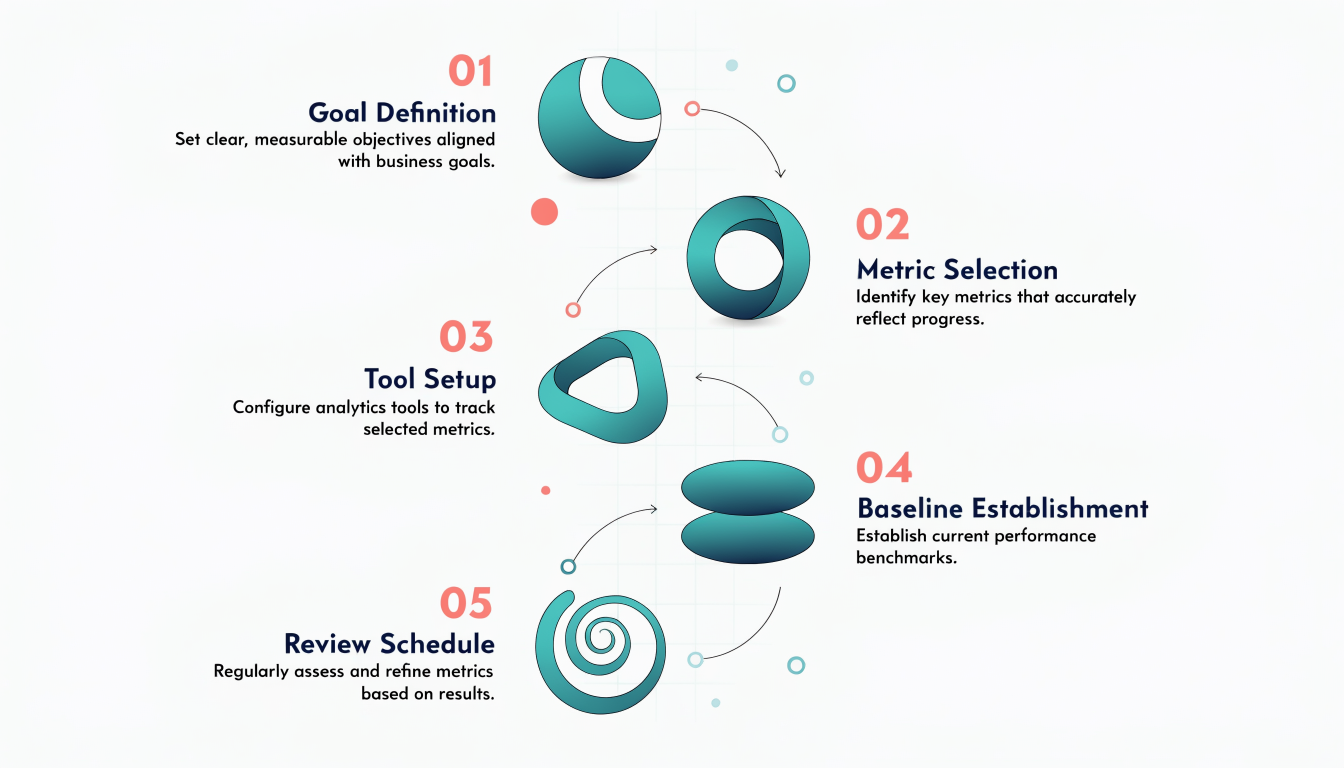
Set up tracking across Google Analytics 4, Google Search Console, and any specialized tools your content strategy requires. UTM parameters are essential for accurate attribution; tag every campaign link consistently so you know exactly which content drives which results. Establish baseline metrics now, before optimizations begin. Baseline metrics provide the reference point for measuring progress.
Finally, create a sustainable review schedule. Weekly reviews catch immediate issues; monthly analysis reveals trends; quarterly assessments inform strategy shifts. Regular tracking ensures these metrics stay prioritized in ongoing meetings and reporting. The system only works if you actually use it consistently.
Common Content Performance Tracking Mistakes to Avoid
Even the most well-intentioned tracking efforts can go sideways. Here are the pitfalls that trip up most content teams, and how to sidestep them.
Tracking everything at once is a common trap. When you monitor 30 metrics across five platforms, you end up drowning in data rather than understanding it. Start narrow. Pick three to five metrics that directly connect to your business goals, then expand only when you've mastered those.
Missing goals altogether makes evaluation meaningless. Without clear targets, you're just collecting numbers. Define what success looks like before you launch content. Is it conversions? Engagement? Time on page? Your baseline matters because industry benchmarks like typical landing page conversion rates of 3-6% help you set realistic expectations.
Ignoring qualitative signals is where many teams miss the real story. Comments, shares, and feedback reveal how your audience actually responds. A piece with modest views but dozens of thoughtful comments might be more valuable than viral content that doesn't convert.
Vanity metrics trap is seductive. Likes and impressions feel good but don't pay bills. Focus instead on metrics tied to actual business outcomes: leads generated, revenue influenced, customer retention. The gap between what feels good and what matters is where most tracking efforts fail.
Finally, inconsistent review schedules mean you miss emerging trends. Set a rhythm. Monthly reviews catch patterns weekly glances might miss, while quarterly deep dives connect dots between content and business results.
Key Takeaways and Next Steps
You now understand the critical difference between vanity metrics and meaningful data. The path forward is clear: choose 3 to 5 primary metrics aligned with your actual business goals, whether that's lead generation, brand awareness, or customer retention. This focused approach beats drowning in dashboards of irrelevant numbers.
Your foundation should include Google Analytics for user behavior, Google Search Console for search visibility, and AI-powered visibility tools that surface opportunities your competitors might miss. Review this data monthly at minimum, and crucially, act on what you find. A metric without action is just noise.
The real power emerges when you connect these metrics to revenue and business outcomes. That's when content performance tracking transforms from an analytics exercise into a strategic asset. Start this week: audit your current metrics, identify which ones actually matter, and set up automated reporting so insights reach your team consistently. Your content strategy will become sharper, faster, and measurably more effective.
Frequently Asked Questions
How often should I review content performance metrics?
Weekly or bi-weekly reviews keep you responsive to immediate trends, but they can be misleading if you're chasing short-term spikes. Instead, treat weekly checks as monitoring and reserve your serious analysis for monthly deep dives. This approach helps you spot patterns that actually matter while avoiding reactive decisions based on one-off traffic bumps.
What tools work best for small businesses on a budget?
You don't need expensive software to start. Google Analytics remains the gold standard and costs nothing. For social media tracking, Buffer offers a free tier that covers basic metrics. Many tools like Google Analytics, Ubersuggest, and Buffer offer free tiers that cover basics. The key is picking one platform and mastering it before layering on additional tools.
How do I measure content performance for AI search?
AI visibility measures how prominent your brand is in AI-generated responses like Google's AI Overviews, ChatGPT, and Gemini. Track whether your content appears in these AI responses by searching relevant keywords and noting your brand mentions. This metric matters because AI visibility increasingly drives awareness and credibility.
What's the difference between engagement and conversions?
Engagement (comments, shares, time spent) shows interest. Conversions (sales, signups, downloads) show intent. You need both, but conversions actually move your business forward. If you're only tracking engagement, you're missing the full picture.
How do I connect content to actual sales or leads?
Use UTM parameters in your links to track which content sources lead to conversions. Set up conversion goals in Google Analytics tied to specific content pieces. Better yet, implement conversion tracking across your entire funnel so you see exactly which articles drive revenue.
Optimize Content Performance with FirstSearch
Content performance tracking isn't optional anymore; it's the foundation of any strategy worth your time. But here's what most teams get wrong: they're measuring the wrong things. Vanity metrics feel good in reports, but they don't drive revenue. Real performance tracking connects your content directly to business outcomes, and that means looking beyond traditional SEO.
The shift happening right now is significant. AI search is reshaping content performance, yet most tracking frameworks ignore it entirely. You can rank perfectly in Google and still miss the audience finding you through ChatGPT, Perplexity, or Claude. That's a blind spot that costs money.
The solution is integrating AI visibility metrics with your existing SEO and engagement data. When you track how often your content appears in AI search results alongside traditional rankings, you get the complete picture. Better yet, when this tracking is automated, you stop wasting hours on manual analysis and start focusing on optimization.
Here's what matters: AI search converts 23x better than traditional results. That's not marginal improvement; that's transformational. Start tracking your AI visibility today. Your competitors who ignore this metric will wonder why your content consistently outperforms theirs. The advantage belongs to those measuring what actually matters.
FirstSearch
FirstSearch.AI Team