Best AI Powered SEO Tools in 2026: Complete Guide
Last Updated: March 27, 2026
Key Takeaways
- AI SEO tools automate keyword research, content optimization, and backlink analysis across traditional and AI search channels
- AI search visitors convert 23x better than traditional organic traffic, making AI visibility a critical business priority
- The best AI tools combine content automation with GEO tracking to optimize for both Google rankings and LLM citations
- FirstSearch's automated content optimization and smart backlink networks help businesses dominate both traditional and AI search results
What Are AI Powered SEO Tools and Why They Matter in 2026
AI powered SEO tools are software platforms that use machine learning and large language models to automate and optimize search engine tasks. They handle keyword research, content optimization, technical audits, competitive analysis, and backlink monitoring at scale, replacing manual work that once consumed weeks of effort.
But here's what matters more: the search landscape itself has fundamentally shifted. ChatGPT, Google's Gemini, Perplexia, and other AI search platforms now answer user queries directly without sending visitors to websites. This isn't a minor trend. AI search visitors convert 23x better than traditional organic search visitors, despite generating lower overall traffic volume.
This creates an urgent problem for businesses relying solely on traditional Google SEO. Research shows that 80% of sources cited in AI search platforms don't appear in Google's traditional top results. You can rank perfectly for conventional search and still be invisible to AI search engines. The optimization strategies differ fundamentally.

The competitive reality is clear: businesses now need both traditional SEO and AI search optimization to capture market share. Modern AI powered SEO tools enable this dual approach by automating the technical work required to succeed in both ecosystems simultaneously. Without them, you're operating with one hand tied behind your back, missing high-intent traffic that actually converts.
How AI Powered SEO Tools Work: The Core Capabilities You Need to Know
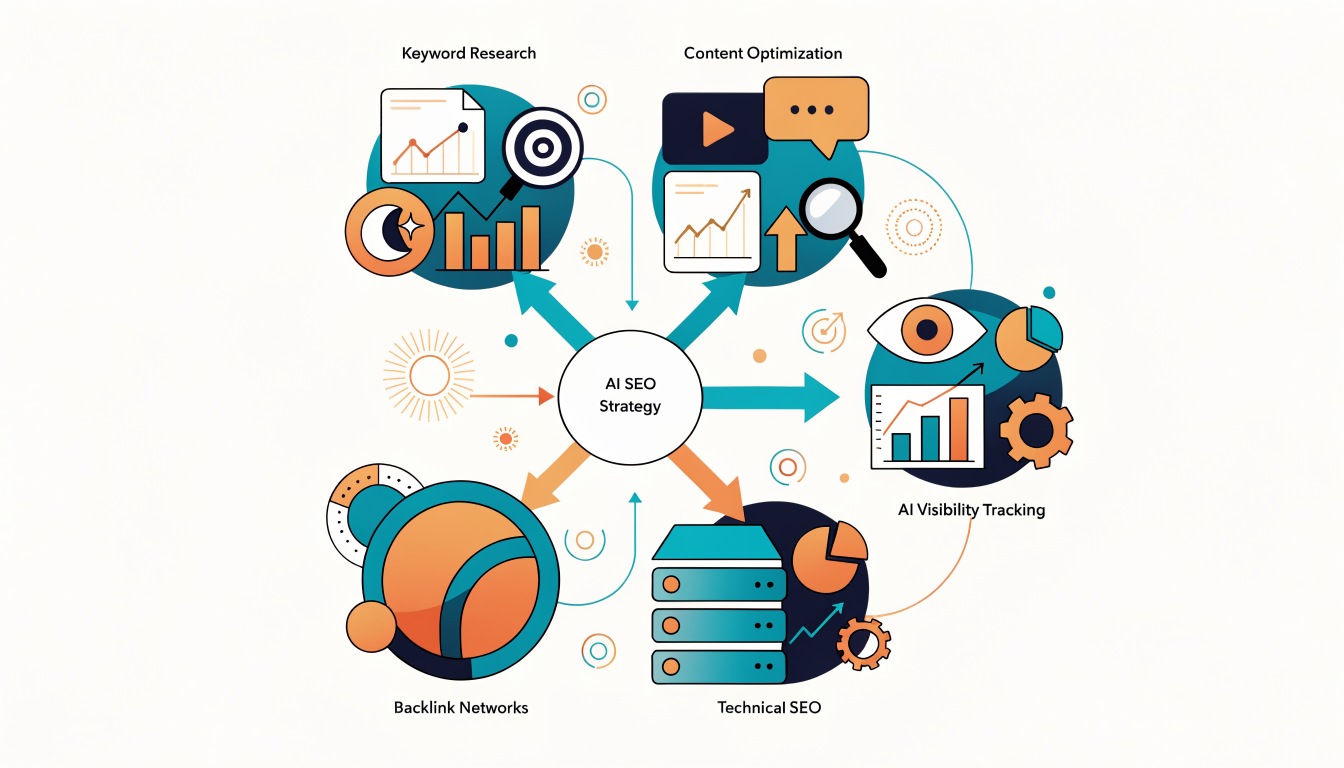
Modern AI-powered SEO tools function through interconnected systems that automate what once required weeks of manual analysis. Understanding these core capabilities helps you identify which tools actually deliver results versus those trading on hype.
Keyword Research and Intent Mapping
AI-powered keyword research uses machine learning to move beyond simple search volume metrics. These tools identify user intent, cluster related search terms, and surface opportunities your competitors miss. Rather than treating keywords as isolated data points, AI analyzes patterns across millions of searches to reveal what users actually want when they type a query.
Content Optimization and Real-Time Guidance
Content optimization tools analyze top-ranking pages and provide actionable recommendations for structure, keyword placement, and readability. The system compares your content against current SERP leaders, flagging gaps in coverage and suggesting specific improvements before publication. This real-time feedback loop eliminates guesswork from content creation.
Technical SEO Automation and Visibility Tracking
Technical issues that once required developer involvement now get identified and prioritized automatically. AI systems crawl your site, detect problems like broken links and crawl errors, and recommend fixes based on impact. Beyond traditional search, these tools now monitor how your brand appears in ChatGPT, Gemini, and Google AI Overviews, a critical shift as AI search referrals reshape traffic patterns.
Backlink Analysis and Authority Building
Smart backlink networks help you build authority across both traditional and emerging AI search channels. AI analyzes link quality, identifies broken backlinks, and finds relevant linking opportunities without manual prospecting. The system learns which links drive actual conversions, not just vanity metrics.
These capabilities work as an integrated system. Keyword research informs content creation; optimization data guides link strategy; visibility tracking reveals where your audience actually discovers you. When properly aligned, AI SEO tools reduce execution time while improving targeting precision and conversion potential.
Top AI Powered SEO Tool Categories: Which One Does Your Business Need?
AI SEO tools fall into five core categories, each solving different bottlenecks in your optimization workflow. Understanding which categories matter most for your business prevents wasted spending and accelerates your path to results.
Keyword Intelligence platforms map search intent and competitive positioning at scale. Tools like Semrush cluster related keywords by search behavior and SERP similarity, while Keyword Insights transforms keyword lists into organized topic clusters, complete content briefs, and even draft articles. Use these when you're starting content strategy or auditing gaps in your keyword coverage.
Content Optimization tools analyze top-ranking pages in real time and suggest specific improvements. Surfer SEO, Clearscope, and MarketMuse compare your draft against SERP leaders, recommending word count, entity coverage, and structural changes before publishing. These are essential if your content ranks but doesn't convert, or if you're competing in saturated niches where precision matters.
AI Visibility Tracking monitors a new frontier: where your business appears in AI-generated answers and LLM citations. SE Ranking's AI Overviews Tracker helps you monitor where and how you're showing up in Google's AI-generated answers, while tools like Rankscale track visibility across multiple AI platforms simultaneously. This category became critical in 2024 as AI overview adoption accelerated.
Technical SEO Automation identifies and fixes crawl errors, on-page issues, and site architecture problems without manual auditing. Alli AI and Botify automatically prioritize fixes by impact, saving weeks of technical work. Choose this category if your site has 500+ pages or if crawl errors are actively blocking indexation.
Integrated platforms like Writesonic and AirOps combine research, writing, optimization, and publishing in one environment. Writesonic offers flexible plans for individual marketers, SEO pros, and full-service agencies with AI agents, SEO tools, and publishing features bundled. These work best for lean teams managing end-to-end content production.
Most businesses benefit from combining two or three categories rather than adopting an all-in-one tool. Start with keyword intelligence and content optimization, then add visibility tracking or technical automation based on your specific constraints.
The Reality Check: What AI SEO Tools Actually Deliver (and What They Don't)
Here's the honest truth: most AI SEO tools won't improve your rankings by themselves. After testing multiple AI SEO platforms, the data shows that speed of content generation doesn't correlate with search visibility. A tool that churns out 50 articles weekly means nothing if those articles don't address what your audience actually searches for or what your competitors are ranking on.
The misconception runs deep. Marketers often assume that adding AI-generated content and sprinkling keywords across pages will move the needle. Post-algorithm updates, this approach falls flat. Simple paraphrasing and keyword insertion stopped working years ago. Google's systems now evaluate content for genuine value, topical depth, and user intent satisfaction.
The real power of AI SEO tools emerges when they serve as accelerators within a larger strategy. They excel at research automation, competitive analysis, and workflow efficiency. They're terrible at replacing strategic thinking and human judgment. The best results come from combining AI capabilities with clear SEO fundamentals: understanding your market, identifying high-intent keywords, and creating content that actually solves problems.
Think of AI tools as force multipliers, not solutions. They help you move faster through repetitive tasks so you can focus on decisions that matter. A tool that identifies content gaps, suggests optimization priorities, and keeps you accountable week after week delivers real value. But it only works if you're applying solid strategy behind it. Without human oversight and a comprehensive system, even the most sophisticated AI tool becomes expensive busywork.
AI Search Optimization (GEO) vs Traditional SEO: A New Competitive Advantage
The rise of AI search platforms like ChatGPT, Gemini, and Perplexity has created a parallel ranking system that operates by fundamentally different rules than Google. Generative Engine Optimization, or GEO, targets these AI systems directly, and the distinction matters because ChatGPT cites webpages that rank in positions 21+ for related queries almost 90% of the time. This breaks the traditional SEO assumption that page-one Google rankings are prerequisites for visibility.
The ranking factors themselves diverge significantly. Content freshness carries 25.7% more weight in AI search results compared to traditional SEO, meaning regularly updated information gains outsized advantage. Additionally, 80% of sources cited in AI search platforms don't appear in Google's traditional results, and only 12% match Google's top 10 positions. This creates an entirely new opportunity: brands can achieve meaningful visibility in AI outputs without dominating Google's organic rankings.

Forward-thinking businesses shouldn't view GEO as replacement strategy; instead, it complements traditional SEO by reaching high-intent users through AI platforms. Average AI search visitor is 4.4 times as valuable as average visit from traditional organic search, making GEO a critical investment for conversion-focused marketers. The competitive advantage belongs to those who optimize for both ecosystems simultaneously, capturing traffic where their competitors remain invisible.
How to Choose the Right AI SEO Tool for Your Business (Evaluation Framework)
Selecting the right AI SEO tool requires evaluating how well it fits your specific business goals, not just its feature list. Start by assessing your current needs: Are you struggling with content production speed, keyword research depth, or ranking visibility? The answer shapes which tool delivers real value.
Integration capability matters more than most marketers realize. Your AI SEO tool must connect seamlessly with your CMS, analytics platform, and advertising tools to create a unified workflow. A tool that requires manual data exports between systems wastes the automation benefits you're paying for. Ask vendors directly about API availability and existing integrations before committing.
Next, evaluate dual-channel visibility tracking. Traditional Google rankings remain critical, but leading tools now monitor performance across AI platforms like ChatGPT and Perplexity. If your target audience increasingly discovers content through AI search, ignoring these channels means missing conversion opportunities. Request a demo showing how the tool tracks both channels simultaneously.
Pricing transparency is non-negotiable. Avoid tools with hidden fees that appear once you scale. Look for pricing that grows with your needs, whether that means additional content seats, higher search volumes, or expanded AI visibility tracking. Request a detailed breakdown of what each tier includes and any usage limits.
Finally, prioritize actionable insights over raw data. The best tools don't just report metrics; they recommend specific optimizations backed by competitive analysis and search intent data. Ask vendors for examples of reports and recommendations their tool generates. Can you export insights for your team, or are you locked into their interface?
These evaluation criteria help you move beyond vendor marketing and identify tools that genuinely accelerate your SEO performance and drive measurable conversions.
Key Takeaways: Building Your AI SEO Strategy for 2026 and Beyond
AI-powered SEO tools have moved from competitive advantage to competitive necessity. The data is clear: Gen AI traffic is growing 165x faster than organic search traffic, and AI search traffic could overtake traditional organic search within two to four years. Waiting to act puts your visibility at risk.
Your 2026 strategy must operate on two fronts simultaneously. First, optimize for traditional Google search using content automation and technical SEO tools that identify real ranking opportunities. Second, establish your presence in AI search platforms now, before the traffic shift accelerates. This dual approach isn't redundant; it's essential.
The conversion advantage is too significant to ignore. AI search visitors convert 23x better than traditional organic traffic, making AI SEO optimization a high-ROI investment regardless of current traffic volume. Start measuring your AI visibility baseline today. Without baseline metrics, you won't recognize the opportunity when traffic begins shifting.
Choose tools that combine automated content optimization with intelligent backlink networks. Avoid platforms that promise results without requiring strategy and continuous optimization. The best tools amplify your efforts; they don't replace strategic thinking.
Begin with one priority: audit your current visibility across both traditional and AI search channels. Identify your strongest content opportunities, then systematically optimize using AI-powered tools. Track results weekly. Adjust your approach based on data, not assumptions.
The window for establishing AI SEO dominance is narrowing. Your competitors are already moving. The question isn't whether to invest in AI SEO tools, but how quickly you can implement them effectively.
Frequently Asked Questions About AI Powered SEO Tools
Do AI SEO tools actually work, or are they just marketing hype? The short answer: they work, but not as standalone solutions. AI tools excel at automating repetitive tasks like keyword research, content optimization, and performance reporting. However, they still depend on professional strategy and interpretation to drive meaningful results. Think of them as force multipliers for your SEO team, not replacements.
What's the realistic price range? Costs vary significantly based on what you need. Many platforms offer free plans with limited features, entry-level subscriptions start around $50 to $100 monthly, and comprehensive enterprise solutions can exceed $500 per month. Your budget should align with your SEO goals and company size. A small business testing AI tools might start with a mid-tier plan, while larger organizations often use multiple specialized tools simultaneously.
Speaking of multiple tools: can I combine different AI SEO platforms? Absolutely. Many successful strategies layer tools for specific functions. One platform might handle keyword research and difficulty analysis, another manages content optimization, and a third tracks backlink opportunities. The key is ensuring your tools integrate properly and don't create conflicting recommendations.
Will AI SEO tools replace human specialists? No. Professionals remain essential for strategy development, competitive analysis interpretation, technical SEO decisions, and adapting to algorithm changes. What changes is the work itself. Specialists spend less time on manual reporting and more time on strategic thinking and client consultation. This shift typically improves outcomes because humans focus on what matters most.
How quickly will I see results? Expect different timelines for different outcomes. Content optimization improvements often appear within 2 to 4 weeks as search engines re-crawl updated pages. Full ranking improvements and traffic increases typically take 2 to 3 months, sometimes longer for competitive keywords. This isn't a limitation of AI tools specifically; it's how SEO works. Patience combined with consistent optimization yields the best results.
Do I need to choose between traditional SEO and AI optimization? No. Successful 2026 strategies optimize for both simultaneously. Traditional SEO fundamentals like site structure, mobile responsiveness, and page speed remain critical. AI tools enhance these foundations by identifying optimization opportunities faster and at scale. The combination of solid SEO fundamentals plus AI-driven optimization outperforms either approach alone.
Ready to Dominate AI Search Results? Start Your AI SEO Strategy Today
The competitive advantage in AI search isn't permanent. Right now, most businesses haven't optimized for LLM-based results, which means the window to establish authority is genuinely open. Within months, that changes. As industry leaders warn, if you don't start optimizing for LLMs now, competitors could establish themselves in AI results and capture the majority of available exposure and visits.
The numbers justify urgency. Conversion rates from AI search run 23x higher than traditional channels because users arrive with intent already formed. They've already decided they want a solution; they're asking where to find it. Being absent from those results means ceding that traffic to competitors who moved first.
The strategic advantage compounds over time. Early optimization builds citation authority, establishes your content as a trusted source within AI systems, and creates backlink networks designed for both Google and AI platforms simultaneously. This isn't a separate effort from traditional SEO; it's an evolution that strengthens your entire visibility footprint.
Waiting for AI search to mature means watching from the sidelines while others capture market share. The best time to optimize was last year. The second best time is today.
Your next step is straightforward: audit your current content against AI search requirements, identify citation gaps, and implement automated optimization that serves both traditional and AI-powered search. The businesses that move now won't just rank higher; they'll own their category before the competition catches up.
FirstSearch
FirstSearch.AI Team